

Today, in our HighMarkets review, we take a closer look at another broker operating under an offshore license and assuring traders of its reliability and commitment to the highest trading standards. However, after examining the platform, it became abundantly clear that its primary goal is to funnel clients’ deposits into the pockets of the project’s owners. Companies like this are far from uncommon, and we hope our articles will help market participants, especially beginners, avoid irreversible financial losses. You can find all the details below.
Key Features
- Company Name: DXA SEYCHELLES LIMITED
- Website: https://www.highmarkets.com/
- Available Contacts: [email protected]; +441252218300 (UK), +971563008077 (AE), +6560544751 (SG), +524497870044 (MX)
- Foundation: 2026
- Services: Forex/CFD trading
- License: № SD218 by Seychelles FSA.
- Initial Deposit: $250
From Sign-Up to Payout
We find it difficult to say anything positive about the design of the official HighMarkets website. At first glance, it looks reasonably attractive, but there is a catch: it only looks good when viewed at 75% zoom. Increase the zoom, and the layout falls apart completely. Text becomes difficult to read, and even the background behaves strangely, changing color in certain sections. We certainly did not expect this from a well-designed website, as polished presentation is usually a hallmark of reputable brokers.
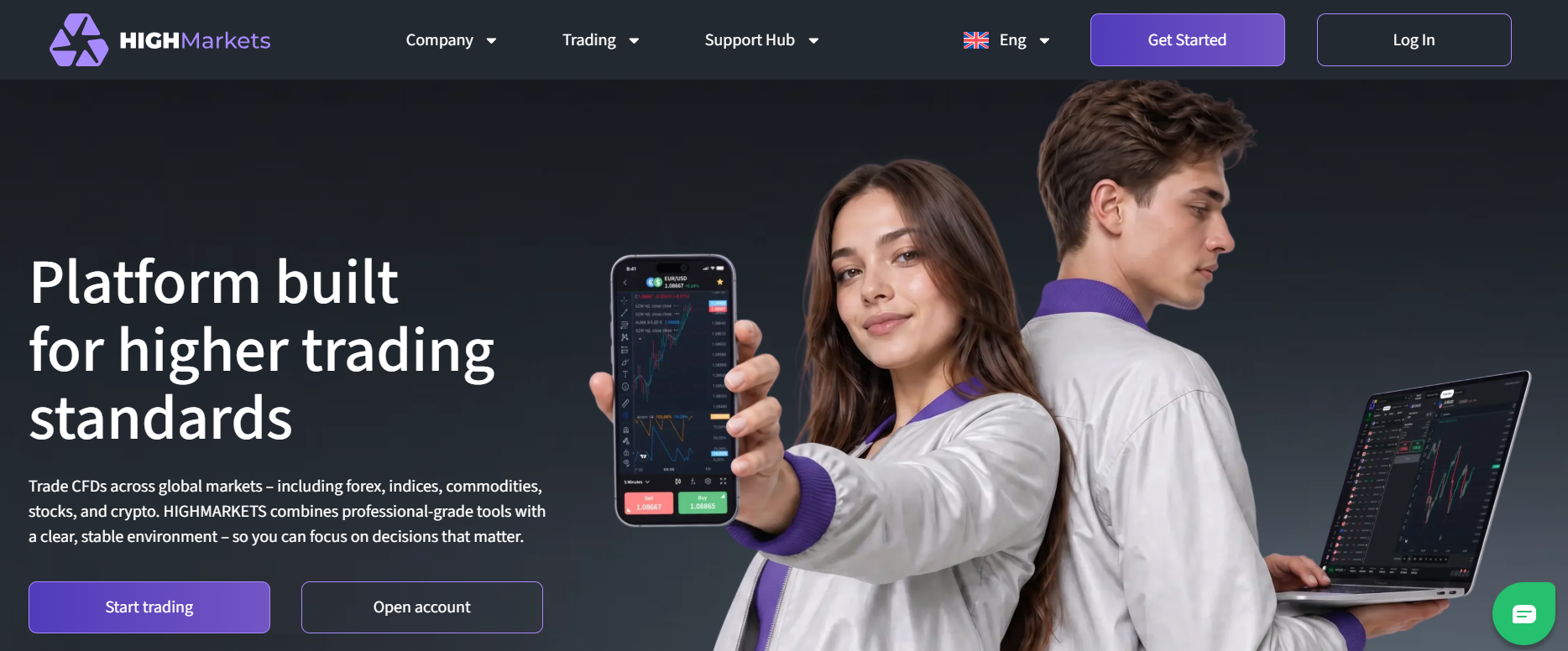
However, the company has far more serious content-related issues. For example, the broker has not considered it necessary to provide detailed information about the available markets, devoting just a single page to the subject. There, it offers only a couple of sentences about each asset class, accompanied by links to the registration page — essentially telling visitors, “Want to know more? Sign up.” Another example is the complete absence of market analysis, a news feed, trading tools, and educational materials.
In short, HighMarkets has done a poor job of presenting itself online. That said, an in-depth analysis of the website’s design and content was never our primary objective. What interests us — and most traders — far more is the registration process and the functionality of the client area.
Opening an account with this broker turned out to be considerably more complicated than we had anticipated. The registration form requires potential clients to provide not only basic personal information but also their date of birth, full residential address, identity document number (passport or National ID), and even their tax identification number. This practice is understandable to a certain extent: collecting such information is necessary for Know Your Customer (KYC) checks and compliance with anti-money laundering (AML) requirements. Nevertheless, in this case, the company appears to have gone too far.
We could understand the need to collect the additional information mentioned above if the company acted as a tax agent for traders. However, as we will demonstrate later, it is not authorized to operate officially in most countries around the world. Naturally, it has no authority to pay taxes on behalf of residents of those countries either. So why does it need such detailed information? How does it intend to use the personal data it collects? We have no answers to these questions.
The questionnaire users must complete during registration is even more puzzling. It includes questions about their employment status, income, and investment experience. Potential clients are also asked how much they have invested over the past year, what level of profit they expect, and so on.
Collecting this kind of information can make sense when a broker operates under the supervision of Tier 1 regulators. Such regulators may use details about an investor’s financial circumstances and experience to determine whether they should be classified as a retail or professional client. However, HighMarkets does not appear to apply this type of classification and does not even mention it. So why does the broker need such a detailed financial profile of a potential client? What specific purpose does collecting this information serve? The platform provides no answers, and the requirement to disclose such an extensive range of personal and financial details is, to say the least, questionable.
Warning! If you were unable to register, do not be surprised. The broker does not accept traders from all countries. Its registration process, client area, and trading terminal clearly suggest that it belongs to a group of individuals operating a good dozen similar websites. The owners seem particularly keen to attract traders from Latin America, the Asia-Pacific region, and the Middle East. European clients are left with the Reverse Solicitation mechanism or the option of registering with assistance from the support team.
There is another notable feature: creating an account does not end with completing the registration form. To gain access to the client area, users must immediately submit copies of their documents for verification and fund their accounts. The latter step can, however, be skipped and completed later. We would recommend doing exactly that, since nobody can guarantee that your verification will be successful. If it fails, the money you have deposited will remain with the company, which has no Refund Policy — and the refund process itself is most likely not even provided for.
The available payment methods also deserve particular attention. According to the FAQ section, HighMarkets accepts debit and credit cards, bank transfers, and ePayments. The availability of each method depends on the country from which the user is attempting to make a deposit.
That sounds reasonable enough, but the broker relies on third-party payment providers to process both deposits and withdrawals. It does not disclose its own payment details or provide clear information about the terms governing financial transactions, such as limits, fees, and processing times. This is understandable for an offshore platform, as access to conventional payment services may be restricted because of the chosen jurisdiction and the requirements imposed by financial service providers. Nevertheless, we believe that this arrangement for handling non-trading transactions sits uneasily with the company’s stated commitment to AML compliance.
Overall, we have already encountered several reasons for concern at this stage. These are not yet definitive red flags, but one thing is clear: HighMarkets can hardly be described as transparent.
Our Trading Experience With HighMarkets
The area where the company’s staff have clearly put considerable effort is its trading conditions. However, even here, the broker does not disclose everything. As mentioned earlier, the Markets page lists the asset classes available to traders but fails to provide a list of specific trading instruments. There is a plausible explanation for this: the Legal section contains a document titled Contract Specifications, which lists not only the available assets but also the trading terms applicable to each instrument.
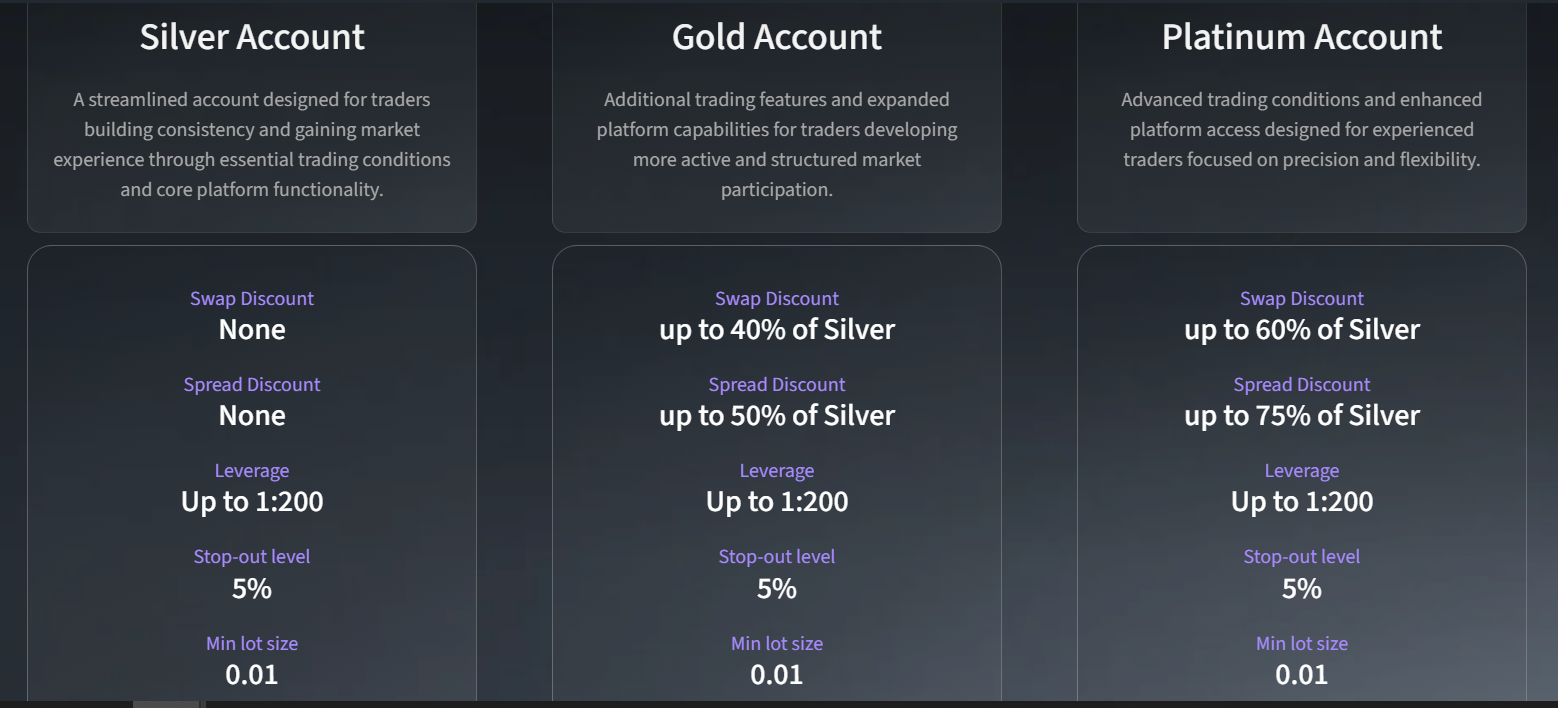
However, we will start with the account types rather than the contract specifications. On the Accounts page under the Trading section, HighMarkets presents just three plans: Silver, Gold, and Platinum.
A note worth mentioning! Users first learn about the company’s trading accounts on the homepage. However, there are four accounts listed there rather than three, with Islamic (Swap Free) presented as a separate option. Yet the Accounts page contains no information about this account, leaving its trading conditions unknown.
As we can see, the published trading conditions for all three accounts are virtually identical:
- Maximum leverage of 1:200.
- Minimum trade volume of 0.01 standard lots.
- Stop-Out level of 5%.
The Gold account, however, promises a 50% reduction in spreads and a 40% reduction in swaps compared with the Silver account. The discounts offered with the Platinum account are even greater: 75% on spreads and 60% on swaps.
We consulted the Contract Specifications document mentioned above to find out the baseline values. Unfortunately, it contains no information on either minimum or average spreads for the available instruments. Without these baseline figures, it is impossible to calculate trading costs or assess the potential profitability of trading with HighMarkets.
Nevertheless, the information provided in the contract specifications gives us sufficient grounds to question whether profitable trading is realistic here — at least for anyone who does not use intraday trading strategies.
Here is a simple example: the document lists both long and short swaps on EUR/USD at -54.83 points. With five-digit quotes, the pair’s average daily price movement is around 200–500 points. Consequently, even without taking spreads into account, holding a position overnight costs a trader between 12% and 25% of the potential profit, assuming they manage to capture the entire move. In reality, this never happens, and the losses are even greater. On Thursdays, when triple swaps are charged, the overnight rollover alone can leave a trader facing a substantial loss.
There are also questions about the information provided on leverage. The specifications list two sets of margin requirements: 3% for retail traders and 0.5% for professional clients. This translates into maximum leverage of 1:30 for the former and 1:200 for the latter. On paper, these terms look fairly respectable, as many brokers regulated by Tier 1 authorities offer similar conditions. Client categorization could also explain why the company asks applicants to complete a questionnaire during registration.
The problem is that HighMarkets does not appear to assign traders to different client categories at all. Immediately after opening an account, we were given access to leverage of 1:200, even though there was no question of meeting the requirements for professional-client status. Is the broker trying to make the risks of trading with it appear less significant than they really are? In practice, leverage of 1:200 pushes those risks well beyond acceptable levels.
Interestingly, the information in the contract specifications and account comparison table is also insufficient to assess the available risk-management options. For example, the company does not disclose the minimum distance for placing pending orders, and the Margin Call level remains unknown. The only relevant parameter provided is the Stop-Out level. However, this is set at an extremely low 5%, which can result in substantial losses when triggered.
Clearly, the supposed commitment to the highest trading standards is nothing more than an attractive fiction created by the project’s owners. We can say with confidence that trading conditions of this kind serve one purpose: to wipe out a client’s deposit as quickly as possible. If the company operates honestly, the client’s losses become its own profits. If it does not, these conditions may help it deflect complaints about misappropriated funds.
We have encountered the HighMarkets trading terminal before while examining other brokerage platforms. Many of those platforms were created by scammers, which gives us yet another reason to question this broker’s reputation.
At first glance, the platform makes a fairly positive impression. Its interface looks modern, and the range of built-in indicators and drawing tools is sufficient even for complex technical market analysis. However, it would not be entirely fair to credit the software developers with all these features. Most of them are provided by the TradingView widget on which the platform is built.
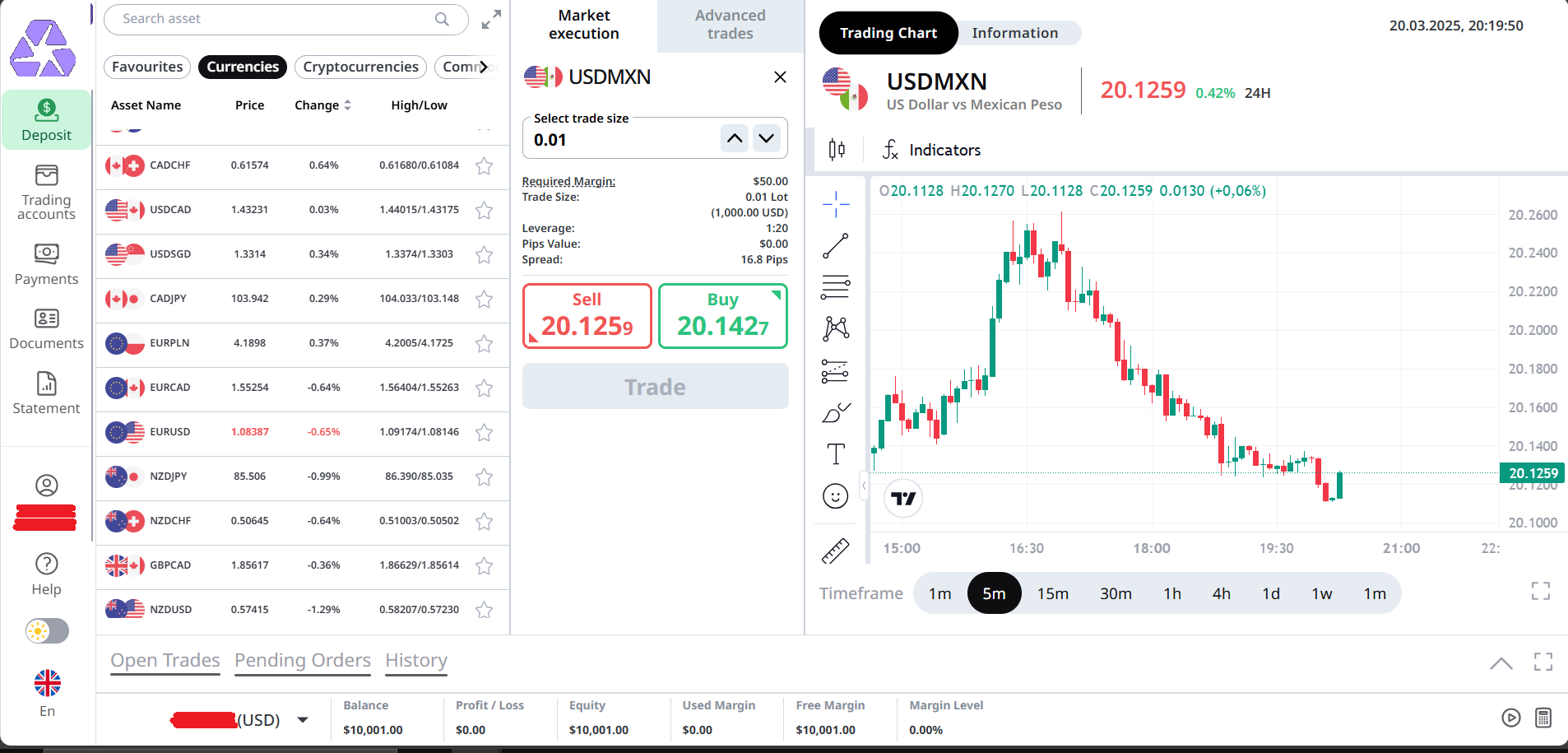
When we look at the terminal’s own functionality, however, the picture is much less impressive. Behind the attractive interface lie several significant shortcomings:
- No full multi-chart mode. Analyzing several charts simultaneously in a convenient layout is not possible.
- No one-click trading.
- Limited workspace customization. Window sizes can be adjusted, but windows cannot be freely arranged to suit individual preferences.
- An inconvenient market overview. Finding and selecting the required trading instruments quickly is difficult.
- No support for third-party indicators or trading robots. The terminal’s standard functionality cannot be extended with additional tools.
These limitations become apparent even during an initial look at the platform. For experienced traders who work with multiple instruments and prefer to customize their terminals, these shortcomings may be particularly significant.
The Reality Check
In the website footer, the Client Agreement, and the About Us page, the broker states that it operates under the management of DXA SEYCHELLES LIMITED. According to the information published by the company, this legal entity is registered in the Seychelles and holds a Securities Dealer license issued by the local regulator, the Financial Services Authority (FSA).
However, the platform’s own statements are not sufficient proof of its regulatory status. We therefore turned to official sources to establish whether the company actually exists and whether the information provided by the broker matches the regulator’s records.
Our first step was to check the business register. We did find an entry numbered C8438281 for DXA SEYCHELLES LIMITED. The company’s details match the information published on the broker’s website. Therefore, its claim to be registered in the Seychelles is supported by documentary evidence.
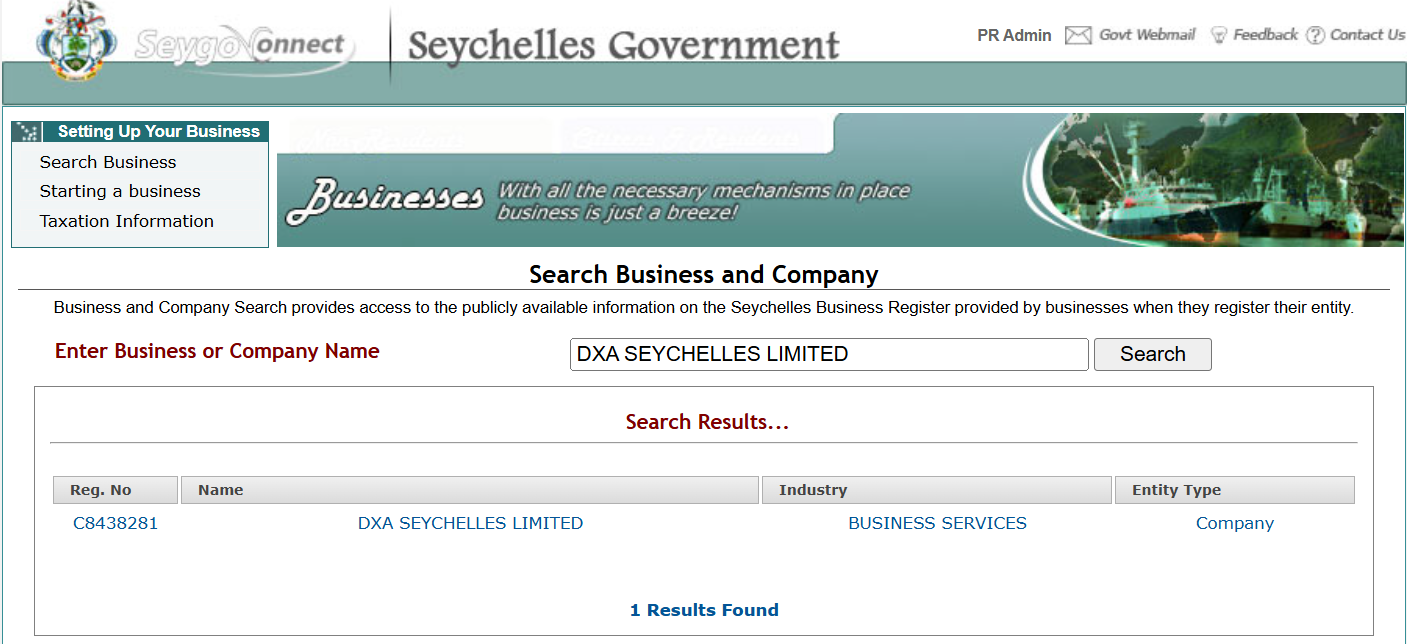
At the next stage, we consulted the records of the Seychelles Financial Services Authority (FSA) to verify whether the company holds the claimed authorization to conduct brokerage activities.

The result of this check was also positive. The FSA register lists a Securities Dealer license issued to DXA SEYCHELLES LIMITED. It also identifies highmarkets.com as a website belonging to the company. This confirms not only the existence of the legal entity and its license, but also the connection between that organization and the trading platform we are examining today.
On paper, the results look convincing: the company is officially registered and holds a valid license. This is a significant advantage over projects that rely solely on unsubstantiated claims.
Nevertheless, it would be a mistake to consider the question of the broker’s reliability settled. Registration and a license alone do not guarantee the safety of client funds or eliminate other risks. We have repeatedly examined the specifics of offshore regulation, particularly in the Seychelles. We have also discussed why a license issued by a Tier 2 regulator — a category to which the Seychelles FSA is generally assigned — should not be regarded as an unconditional guarantee of investor protection.
A note worth mentioning: The regulator’s register revealed another interesting detail: DXA SEYCHELLES LIMITED is associated not only with HighMarkets but also with another trading platform, Algobi (algobi.com). We examined the second project’s official website and noticed striking similarities between the two platforms. This raises a reasonable question: why would one company operate two such similar projects? Especially when Algobi’s online reputation is far from positive.
The existence of multiple brands does not, in itself, prove that their owners are acting dishonestly. However, such an arrangement warrants closer scrutiny, particularly when the projects are so similar. In any case, the connection between HighMarkets and Algobi is an additional factor that should not be overlooked when assessing the risks.
How Long Has HighMarkets Been in the Game?
Examining the history of a trading platform is just as important to us as analysing its legal status and regulatory oversight. Our main objective is to establish the broker’s exact launch date and determine whether it has built a reputation that the trading community can genuinely trust.
Unfortunately, the creators of HighMarkets have chosen to conceal the actual age of their project from potential clients. With no official information available, we had to turn to public sources to reconstruct its timeline.
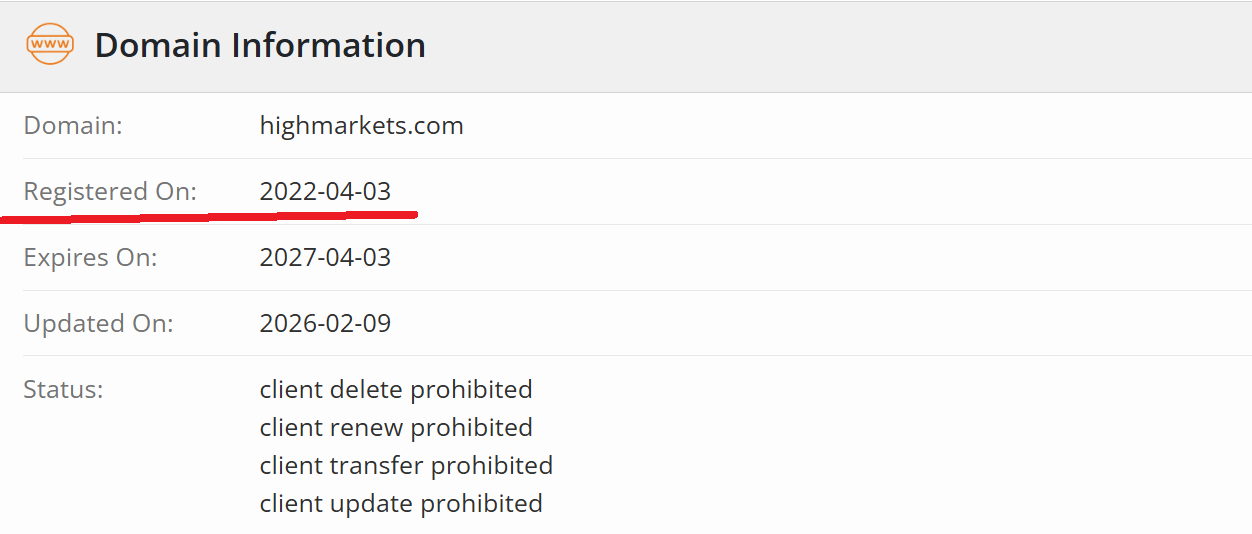
A WHOIS lookup shows that the highmarkets.com domain was created in April 2022. This means the domain name itself has been around for more than four years. However, we have good reason to doubt that HighMarkets has been serving clients for that entire period.
First, if the platform had genuinely been operating for so many years, it would have gained a considerably stronger online presence. Second, a broker’s actual activity over such an extended period would inevitably leave traces in web archives.
It was while examining archived snapshots that we uncovered the most interesting details. Records from the Wayback Machine show that the domain remained associated with the hosting provider rooted.com until 2026. The first full snapshot of the broker’s active website dates back only to August 2026.
This leads to a clear conclusion: the domain registration date cannot be used as evidence that the project has a long track record. All the available evidence suggests that the website was launched only in the summer of 2026. This means that, by the time of writing this HighMarkets review, the platform had been operating for just three to four months.
This distinction is critical for an objective assessment. Four years of established operation and four months are entirely different things. Building a reliable, fully developed brokerage service that traders can trust in such a short period is simply unrealistic.
Extra Fraud Indicators
To conclude, we would like to say a few words about HighMarkets’ online reputation. The findings were entirely predictable: at the time of writing, there are no mentions of this broker on independent platforms such as Trustpilot, Reviews.io, or similar websites. However, this absence is understandable. The project has not been around long enough to build a substantial client base willing to share its experiences.
The situation is more interesting on specialized trading portals. The brand has already appeared in the directories of WikiFX, FastBull, and several other services covering the trading industry. Their assessments, however, differ dramatically. For example, WikiFX’s scoring system gives the platform a very low rating of just 3.46 out of 10. FastBull, by contrast, awards it a relatively high score of 7.8 out of 10.
In our view, this discrepancy can be explained by the fact that FastBull takes user reviews into account, and some of these reviews appear to have been commissioned. We believe this project looks much more like another scam than a legitimate offshore company genuinely committed to working fairly with investors.
Is HighMarkets the Right Fit?
Based on our findings, we have serious doubts about the integrity of HighMarkets’ operations. We cannot regard a Seychelles FSA license as an unconditional guarantee of reliability. Companies holding such licenses vary widely: some have decades of honest market experience behind them, while others are established by scammers who aim to collect a few thousand dollars within a couple of months and then disappear. Which category does this platform belong to? Its track record, the information published by the broker, and its trading conditions suggest the latter. We are convinced that you are more likely to lose all your money here than to make a profit.

A scam in disguise
I checked Highmarkets licence and was impressed by what appeared to be solid trading conditions, so I immediately opened an account and deposited $10,000. At first, everything went smoothly, but then a series of inexplicable problems began. Just before that, a manager had called me and suggested increasing my deposit further so that my profits would grow faster. I declined, and the very next day, the terminal started throwing errors, orders were executed with slippage, and sudden price spikes kept triggering my stop-losses.
When I started complaining, the support team stopped responding altogether. And that is not all: my withdrawal request has now been pending for a month, with nobody processing it. It looks like these really are SCAMMERS after all, albeit ones that have done a good job of disguising themselves…