

Projects that present themselves as legitimate brokerage firms appear online with remarkable regularity. In this Pure Market Broker review, we take a closer look at yet another such case. The company modestly describes itself as “Not Your Ordinary Broker” and promises clients access to 400 assets, order execution in less than 1,200 milliseconds, and protection from two financial regulators. However, it has yet to fully convince us of its reliability. That is why we decided to investigate whether traders are actually being lured into what may simply be another scam project. You can find the results of our investigation below.
Key Features
- Company Name: Pure M Global Limited
- Website: https://puremarketbroker.com/
- Available Contacts: [email protected]
- Foundation: 2016
- Services: Forex/CFD trading, copy trading, PAMM investments
- License: № 14801 (Class A, B, C) by VFSC; № T2023313 by MISA
- Initial Deposit: $100
From Sign-Up to Payout
For some reason, we had expected the information resource of a Forex/CFD broker to look somewhat different from the official Pure Market Broker website. For example, the color schemes in both the light and dark themes are far from ideal, while the lack of relevant images makes the pages look rather bare. There are also obvious scaling issues, which are particularly noticeable in the page footers. Apparently, ten years of the company’s existence have not been enough to get these issues sorted out — although perhaps no one has ever really tried.
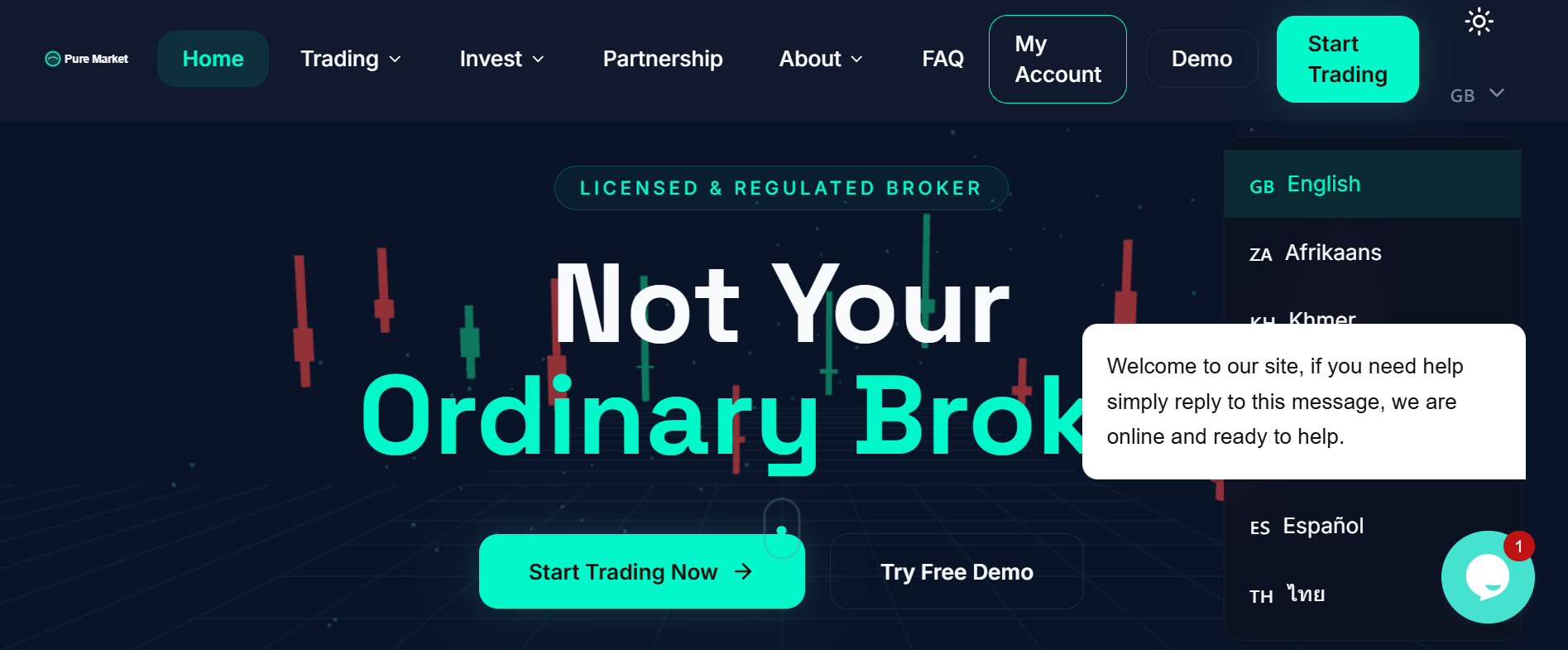
However, the poor design is not the biggest problem with this service. Far more concerning is the fact that the content does not really meet traders’ needs and interests:
- There are no descriptions of the available markets. All the broker provides is a list of them and the number of CFDs available for trading in each market.
- Contract specifications are not provided. Perhaps the platform’s owners expected users to view them directly in the trading terminal when using a demo account. However, the broker does not even mention any guarantees that trading conditions on demo accounts will exactly match those on real accounts.
- There is no market analysis on the website either, nor are there any educational materials. The only exception is a glossary, which the creators of offshore brokers seem to consider something every trader necessarily needs.
- Pure Market Broker also does not consider it necessary to provide much information about the company itself, limiting this section to a couple of general statements and details about its registrations and licenses. Traders would normally expect more, such as a detailed history of the firm, financial statements, and an introduction to its team.
In short, the project’s official website is hardly the best example of how a broker should present itself online. And this is not only a matter of the completeness and quality of the information provided.
For instance, the registration process turned out to be unexpectedly cumbersome. The issue is that the registration form asks prospective clients to provide not only their full personal details, including their date of birth and address. This part is understandable: such information is required for a full KYC procedure and compliance with AML policies.
What is less clear is why the form also includes questions about the user’s employment, income level, and investment experience — right down to the amount they invested over the previous year. Such questions would make sense, for example, at European brokers, where this information is used as a basis for determining whether a trader falls into the retail or professional category. However, Pure Market Broker does not work with European or UK clients, does not carry out such categorization, and offers the same trading conditions to everyone. So why does the company need this additional client data? How does it intend to use it? This approach is somewhat concerning.
Interestingly, completing the registration process requires clients to immediately submit copies of their documents for personal-data verification. In addition, new clients are effectively required to read and sign the Terms & Conditions — without signing them, there is no access to the client area. The trading account is also not created until the company’s employees have verified the documents, while deposits and withdrawals remain unavailable as well.
In other words, this final stage of the registration process is not typical of offshore brokers. From a security perspective, that is not necessarily a bad thing; the only remaining task is to convince potential clients that this is indeed the case.
It is also worth noting that, according to its own FAQ, Pure Market Broker uses bank transfers and cryptocurrency transactions for payments, including funding deposits and withdrawing client funds. This is a fairly understandable approach for an offshore broker that may have limited access to payment services because of its choice of registration jurisdictions.
We are left with just one question for the platform’s representatives: how do cryptocurrency transactions fit with its AML policy, and does a broker without the required local Class D license violate Vanuatu laws when dealing with these assets? We will return to this issue a little later.
Our Trading Experience With Pure Market Broker
We began our examination of the trading conditions offered by this “Licensed & Regulated” broker (as it describes itself) with a list of the assets available for trading. This information can be found on the website’s homepage. Unfortunately, it is rather limited and only allows users to see the number of instruments available across different markets:
- 75 Forex currency pairs.
- 3 CFDs on commodities and 8 on metals (judging by the relatively small number of contracts, we assume these are energy commodities and precious metals).
- 13 CFDs on stock indices.
- 292 stock contracts.
- 23 cryptocurrency CFDs.
The number of available instruments is certainly not impressive. Still, for most Forex/CFD traders, the list covers all the most interesting assets. In fact, we would go even further: it is somewhat broader than the selection offered by most similar offshore brokers. However, as we have already noted, without an exact list of instruments and detailed contract specifications, this information is practically useless. Unfortunately, Pure Market Broker does not seem to take this point of view into account.
As a result, the descriptions of the trading accounts available on the platform have effectively become the only source of information about the trading conditions. There are only two of them, by the way: MT4 Standard and MT5 Standard. Obviously, their main difference is the trading platform used — MetaTrader 4 or MetaTrader 5, respectively.
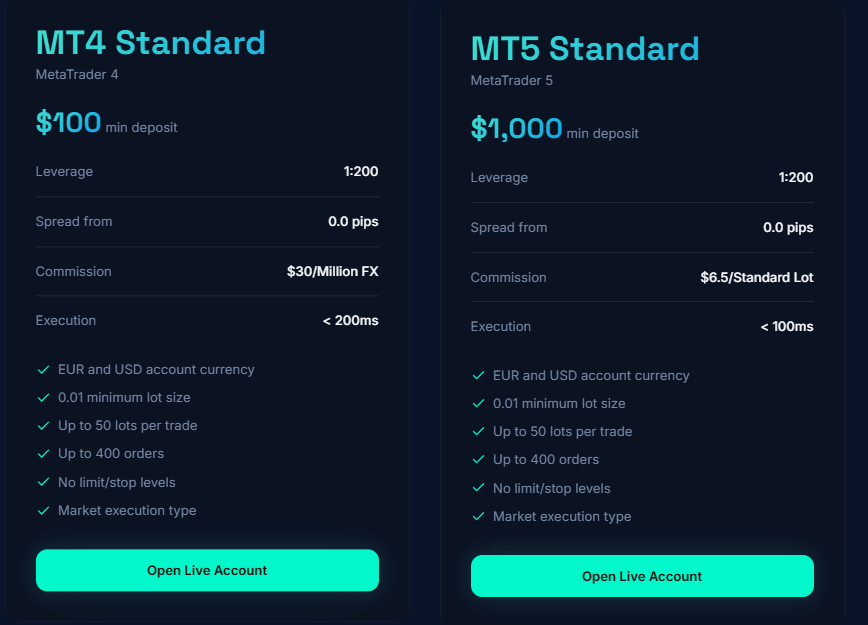
As we can see, the two accounts share many of the same parameters:
- Maximum leverage of 1:200.
- Spreads starting from 0.0 pips.
- Minimum trade volume of 0.01 standard lots and a maximum of 50 lots.
- A maximum of 400 open and pending orders.
- No restrictions on the placement of pending orders (meaning that orders can apparently be placed as little as 0.1 pips away from the current market price).
There are also some differences. Traders who prefer MT4 can start trading with a deposit of USD/EUR 100, while those opting for MT5 need a deposit ten times larger. As for the contract specifications, the main difference concerns trading commissions: MT4 Standard charges $3 per standard lot, while MT5 Standard charges $6.50.
Let us start by discussing the parameters that Pure Market Broker has chosen to disclose. We might as well begin with leverage.
By offering leverage of 1:200, the broker allows traders to control a position worth 200 times the size of their deposit. In other words, with $100 in your account, you can open a position worth $20,000. The key point to understand about leveraged trading is that both profit and loss are calculated based on the full position size, rather than the amount of the deposit.
Let us illustrate this with a simple example:
- EUR/USD trade.
- Deposit: $100.
- Leverage: 1:200.
- Position size: $20,000.
A price movement of just 0.5% against an open position is hardly an unusual event in the Forex market — it can happen within a matter of minutes. At the same time, the trader would incur a $100 loss. In other words, the entire deposit could be wiped out by a price movement of less than 1%. By comparison, without leverage (1:1), the same 0.5% movement on the same amount of the trader’s own money would result in a loss of just $0.50.
Traders might object: with leverage this high, a 0.5% move in the right direction could also generate a 100% return on the deposit. That is true, but the risks are still considerably greater, and there are several reasons for this:
- Margin Call and Stop Out can come quickly. When losses approach the size of the deposit, maintaining the position becomes impossible: the account will need to be topped up (triggering a Margin Call), after which the position may be forcibly closed (Stop Out), turning what were previously unrealized losses into actual losses.
- Market volatility does not take the size of your deposit into account. Sharp moves of 1–2% or more occur regularly: following the release of economic data, central-bank statements, geopolitical events, or gaps when markets reopen after weekends. With leverage of 1:200, such a move can wipe out the entire deposit or even result in a negative balance if the broker does not provide negative balance protection.
- Emotional pressure increases disproportionately. When every small price movement translates into large amounts of money relative to the account balance, traders can start making decisions based on fear and panic rather than analysis. This can lead to prematurely closing profitable positions while holding on to losing ones. This is a classic pitfall of leveraged trading.
- The cost of holding a position can also accumulate quickly. With highly leveraged positions, swaps calculated on the full position size can eat into available capital faster than a trader might expect.
It was precisely because of these risks that, in 2018, the European Securities and Markets Authority (ESMA) introduced restrictions on CFD leverage for retail clients, limiting it to 30:1 for major currency pairs and setting lower limits for less liquid or more volatile assets.
Leverage of 1:200 and higher is typically offered by offshore brokers operating outside jurisdictions with strict regulatory requirements. This adds another category of risk: counterparty risk, including the safety of client funds, the ability to withdraw money, and the reliability of order execution. The case of Pure Market Broker falls into this category.
Now let us turn to trading costs. A commission of $3 per lot is roughly equivalent to a spread of 0.32 pips, while $6.50 per lot is equivalent to approximately 0.65 pips. If the actual spreads are indeed close to 0.0 pips, commissions become the broker’s only regular source of trading-related revenue. Do you really think it has limited them out of the goodness of its heart?
We have our doubts. Obviously, the broker may be counting on other, more substantial sources of revenue. Swaps could be one of them (which may explain why the company does not disclose their size). Another possibility is that traders’ losses ultimately become the firm’s profits. This means the broker’s clients should be prepared for various surprises, including potential issues with price quotations.
There is little point in discussing Pure Market Broker’s trading terminal in detail. You have already understood that the broker uses software from MetaQuotes, in two versions: MetaTrader 4 and MetaTrader 5. The advantages and disadvantages of these platforms are well-known to virtually every trader. We will only note one fact: the legitimate use of this software indicates that the platform has an officially documented registration with the relevant software provider.
The Reality Check
We have established that the broker operates through a legally registered management company. The remaining task is to examine the details, including whether it actually holds the licenses it claims to have. The website’s creators state that the platform operates in several jurisdictions and is subject to regulatory supervision. They even provide information about the regulators involved.
According to the company’s website, Pure Market Broker represents two firms:
- Pure M Global LTD, registered in the Republic of Vanuatu and holding a license issued by the local financial regulator, the Vanuatu Financial Services Commission (VFSC).
- Pure Market Africa, registered on the autonomous island of Mwali (Moheli), Comoros Union, and holding a brokerage license issued by the Mwali International Services Authority (MISA).
We began verifying the information provided by the platform by searching the Vanuatu registers. A check of the business registry showed that a company named Pure M Global LTD is indeed listed there under the International Companies section.
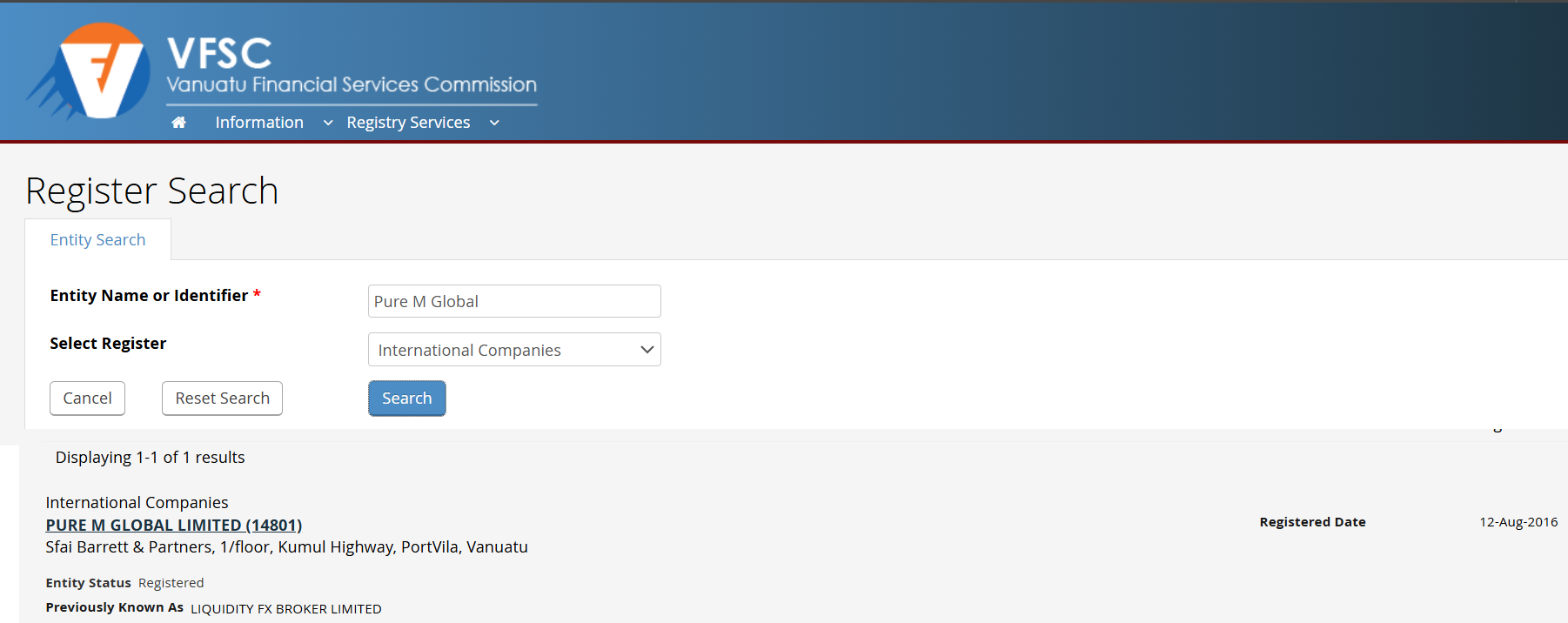
The record was assigned number 14801, which matches the number indicated on the company’s website. The legal entity was registered back in August 2016. Interestingly, the company previously operated under the name Liquidity FX Broker Limited. According to the information on the registration of the business name PURE MARKET BROKER, the name change took place in March 2024.
We also checked the information regarding the licenses issued by the local financial regulator, the Vanuatu Financial Services Commission (VFSC). The broker has even posted copies of its Class A, B, and C licenses on its website (links to the documents can be found on the About Us page). According to the information contained in these documents, the licenses were issued in March 2024.

The existence of these licenses was confirmed in the regulator’s database. The only question that arose was why the licenses were issued to the company under its new name before the trading name itself was registered. However, this does not appear to be particularly significant, since the company has continued to exist since 2016.
A much more interesting fact is that another broker, GT Markets (gt-markets.com), operates under the same license number. However, public access to its website is currently unavailable: attempts to open its pages result in a request for a username and password. Its reputation, meanwhile, is rather controversial. For example, WikiFX gives it a score of 1.82 out of 10, while all nine reviews on Trustpilot give it the highest possible rating. This appears to suggest that the company’s owners may be actively using paid or commissioned publications to build an online reputation for their projects, which does little to enhance the credibility of these platforms.
Worth noting! The list of assets available to traders includes 23 cryptocurrency CFDs, and non-trading transactions can also be carried out in cryptocurrencies. However, the current Class A, B, and C licenses do not authorize the company to operate with digital assets. Accordingly, in this respect, Pure Market Broker is in breach of the applicable laws of the Republic of Vanuatu.
There is another troubling detail. The same About Us page contains a link to a document allegedly issued by the Mwali International Services Authority (MISA), the financial regulator of the autonomous island of Mwali (Moheli), which is part of the Union of the Comoros. However, the link leads to a non-existent page — a 404 error — even though Pure Market Broker claims to use this license as part of its operations.
We checked the regulator’s databases and found the following:
- Pure Market Africa Ltd, the company mentioned by the broker, is indeed registered in Mwali. It was incorporated in 2023 under registration number HY00623407.
- It obtained a license from the local financial regulator, MISA, under number T2023313 on June 28, 2023, and renewed it in 2024.
- The company operated through the website puremarket.global, which is no longer active.
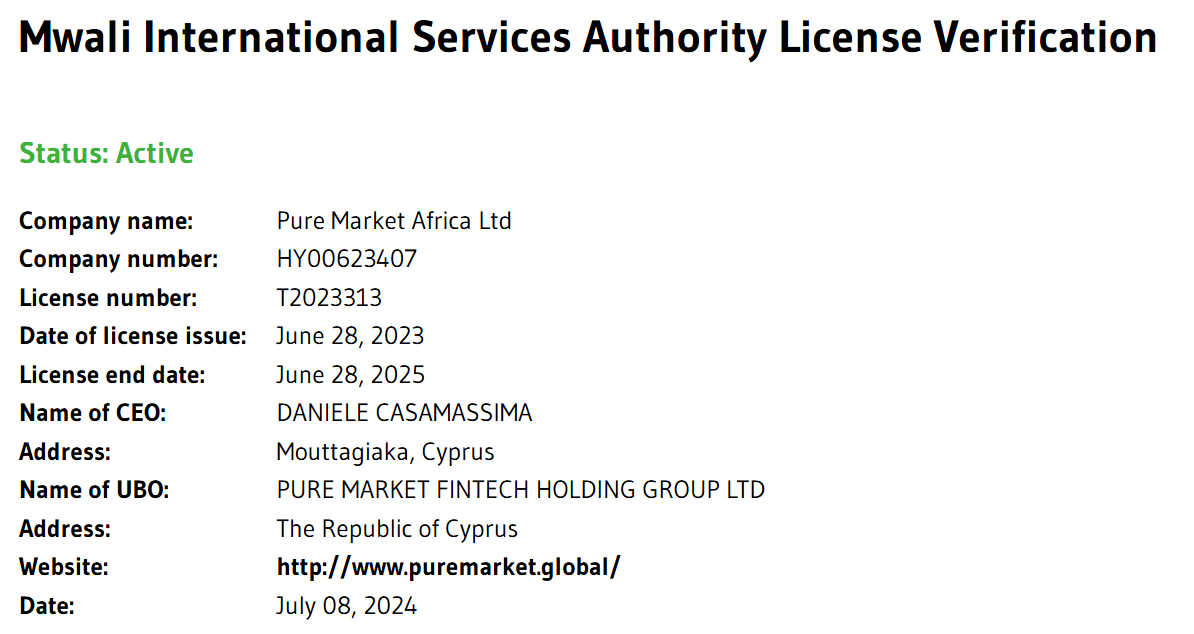
However, there is no information in the database regarding a subsequent renewal of the license. Moreover, Pure Market Africa Ltd is currently included by the regulator on its list of Suspended Companies. This indicates that the company is awaiting payment of the required fee. However, as we can see, a year and three months have already passed since the date by which the payment was due. Most likely, no one intends to make it. This would also explain the link to the non-existent page on the broker’s website.
Worth noting! The puremarket.global website was active from 2023 until the summer of 2025, and we found no clear indication of why the company decided to abandon it. Attempts to find user opinions about the website online have also been unsuccessful, as search results primarily lead to information about Pure Market Broker, the company we are examining today. We have not been able to determine the reason for the change of domain name.
Thus, we have established that the people behind the project have considerable experience in setting up brokerage businesses. At the same time, it would be difficult to describe the operations of these platforms as transparent and fully compliant with the law.
Pure Market Broker appears to follow the same pattern. Despite holding a valid Vanuatu license, the company appears to violate the country’s laws in certain aspects of its operations. As for the MISA license, the company appears to be even more misleading: it presents the license as active, even though the document has expired and apparently no one has taken steps to renew it.
How Long Has Pure Market Broker Been in the Game?
We have already seen that the information in the broker’s history is rather contradictory. The company was registered in Vanuatu in 2016, but its current trading name was only added to the register in 2024. The VFSC license was also obtained that year, while the MISA authorization documents were issued a year earlier — but their validity has already expired. To make sense of this, we had to turn to information from open, independent sources, such as data provided by WHOIS services.
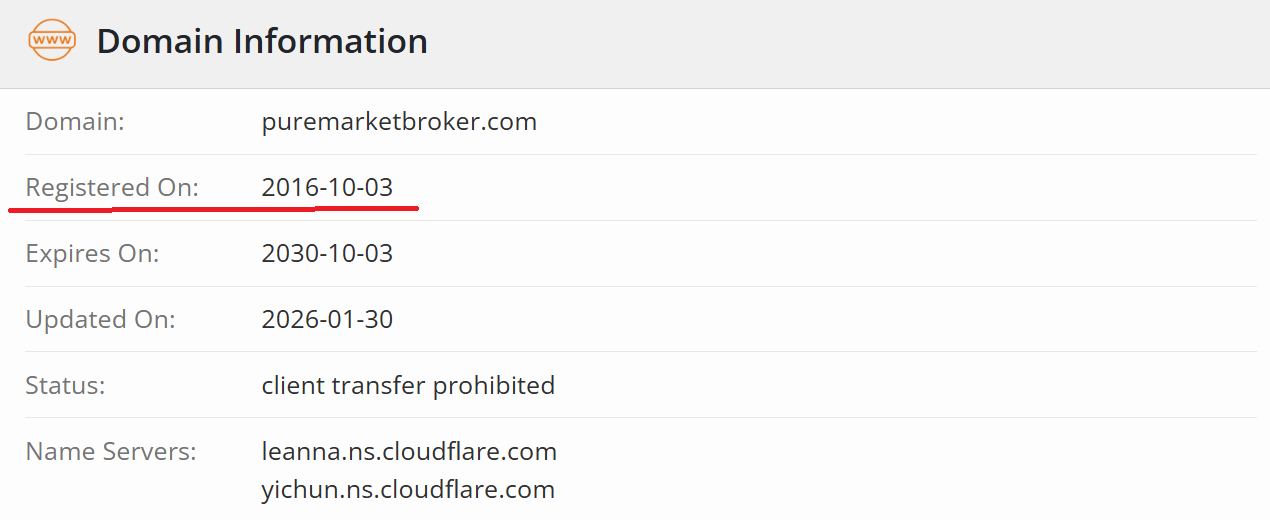
The results of our investigation were somewhat unexpected. WHOIS data showed that the broker’s active domain, puremarketbroker.com, was registered in October 2016, shortly after the company was established in Vanuatu. But the most interesting part is that the platform’s website was launched on this domain soon after its registration and was operated specifically by Liquidity FX Broker Limited.
This means that the Pure Market Broker trading name has actually been used by the project’s owners for quite some time. Other sources confirm this as well. For example, the first puremarketbroker.com review on Trustpilot appeared as early as January 2, 2019. This suggests that the project has been operating for almost ten years, making the constant changes involving company names and licenses even harder to understand.
Extra Fraud Indicators
We were also concerned by the ambiguous picture presented by reviews of Pure Market Broker’s activities. As mentioned above, the first Trustpilot review appeared in early 2019. By the time we prepared this article, the platform had accumulated only 37 comments. At first glance, that is not particularly unusual and could be consistent with the figures for an average broker.
However, the proportion of highly positive reviews — 67% — raises some doubts, especially considering that they contain virtually no specific or verifiable facts. It would appear that the project’s owners have remained true to their usual approach and may be commissioning positive reviews to build a favorable image for yet another one of their ventures.
There are also authors who are dissatisfied with the company’s services, and there are quite a few of them — 28%. As might be expected, the main complaint concerns the inability to withdraw funds.
Another warning sign is the low assessment from industry experts. For example, WikiFX gives the broker a score of just 1.28 out of 10 and describes the company as a clone.
Is Pure Market Broker the Right Fit?
After completing our Pure Market Broker review, we were still unable to reach a definitive conclusion about the broker’s origins. Some facts — such as its long operating history, official registration, and license — suggest that we are dealing with a conventional offshore brokerage. However, alleged violations of the laws of its country of registration, attempts to mislead users about its regulatory status, as well as problems with the disclosure of trading conditions and the transparency of non-trading operations, indicate that traders should approach the platform with caution.

Nothing but a scam
At first, the broker seemed quite reliable and promising, and the opinions of some traders I knew made me feel comfortable trusting it. Who would have thought that all of this would turn out to be nothing but a scam? Pure Market Broker certainly tried to maintain the appearance of a legitimate company. At the same time, they had no hesitation in taking my money. I lost more than $5,000 here in just one month. Now I am absolutely convinced that this was a scam, and I would not recommend depositing money with them to anyone.