

Today, we introduce you to a Forex/CFD broker that promises traders “Creating a new financial future” and claims that it is time to “Make a breakthrough in trading.” Of course, it has prepared everything for this: access to 350+ trading instruments, competitive trading conditions, and operations under the supervision of the Seychelles financial regulator. Unfortunately, even a brief look at the broker shows that potential clients are being lured into yet another scam project designed to steal the money of those who believe its attractive promises. You understood everything correctly: in our Seemarket review, we expose a platform created by scammers and present the facts that reveal it.
Key Features
- Company Name: Suxxess FX Ltd
- Website: https://www.seemarket.com/
- Available Contacts: [email protected], [email protected]
- Foundation: 2026
- Services: Forex/CFD trading
- License: Seychelles FSA No. SD204
- Initial Deposit: $250
From Sign-Up to Payout
If judged solely by its visual appearance, the official Seemarket website could indeed create the impression of a fully-fledged representative office of a regulated broker. The designers chose a rather strict color scheme that looks quite appealing, but unfortunately, they missed the mark both with the font sizes and the choice of thematic images. As a result, they never managed to make full use of the template’s capabilities.
At the same time, the website’s content is difficult to look at without disappointment. There are exactly three pages that could be considered informational: the Home, Contact, and Legal pages. It seems that the creators of the project simply decided not to put in much effort and merely wanted to establish the broker’s presence online without publishing any information that could be useful or relevant to potential clients. Therefore, the website does not provide:
- Information about available markets, a list of trading instruments, or contract specifications.
- Detailed information about the broker and its management company.
- A list of payment methods and the conditions for non-trading operations.
- Analytical and educational materials.
- Useful tools for traders, such as an economic calendar, etc.
However, even the pages that do exist contain plenty of problems. For example, the contact information is limited to a couple of email addresses, while the documents section lacks some essential documents, such as an AML/KYC policy, which has effectively become a standard part of any broker’s documentation.
It is clear that the informational value of this website is practically zero. Yet providing clients with adequate information is one of the important responsibilities of any such project. We consider this attitude a genuine Red Flag.
However, Seemarket’s problems are not limited to the informational content of its website. This becomes easy to see if you decide to register with the broker and explore its client area.
The account creation process is extremely simplified. A prospective client only needs to enter their first and last name, email address, and password for authorization, as well as agree to the Terms & Conditions and Privacy Policy. After that, they receive access to their personal client area without any additional checks.
The functionality of the client area also leaves much to be desired. To begin with, the client’s profile requires almost no additional personal information. In addition to the details provided during registration, the user only needs to enter a phone number and country of residence. The broker does not collect any other information.
Most importantly, the broker does not even mention verification. It immediately becomes clear why there is no KYC/AML policy among the available documents. This raises a serious question: did it actually obtain authorization from the regulator, even an offshore one, if it completely ignores one of the most important requirements? We will answer this question a little later.
The process of funding the account looks no less impressive. Seemarket offers clients a choice of bank transfer, debit/credit cards, or cryptocurrency. However, the choice ultimately makes little difference: the transaction cannot be completed directly through the client area, and a request must instead be sent to the company’s representatives. The trader is then left to wait for them to get in touch.
Most likely, during this conversation, the trader will be informed of the appropriate payment method and the recipient’s payment details. We also suspect that they may try to persuade the client to increase the transaction amount.
This is how scammers typically operate:
- They do not disclose their own payment details, thereby avoiding the attention of tax and regulatory authorities, and accept payments to anonymous crypto wallets or cards/accounts belonging to money mules.
- They do not use their website to establish a proper online presence, instead attracting new clients through other methods (for example, by cold-calling phone numbers obtained from unknown sources), which are not always lawful.
- They make every effort to persuade clients to deposit a large amount of money.
We can see all of these scammer tactics in the broker’s actions. Are they appropriate for a regulated platform that can be trusted? We are convinced that they are not.
In fact, the registration and account funding process could be improved in the future. The interface clearly states that this is a demo version, which applies to both the payment methods and the terminal.
Our Trading Experience With Seemarket
We would like to begin our examination of the broker’s trading offer with a simple question about the available markets and assets. However, as you have already understood, we were unable to get an answer. The only information we could find on the homepage was the number of trading instruments (more than 350) and a mention that Forex pairs are available for trading after all (at least, they are the only instruments for which leverage of up to 1:200 is advertised). However, we have already assessed the “completeness” of this information when reviewing the official website. By the way, we also mentioned there that contract specifications are not available on its pages either.
Perhaps the necessary information could be obtained through the trading terminal. Yes, it is unavailable to ordinary visitors to the Seemarket website, but at least registered clients should be able to assess the trading conditions before funding their accounts.
We were very surprised to see that traders are offered a web version of MetaTrader 4. However, if the company is indeed officially registered, there should be no obstacles to obtaining a trading server from MetaQuotes. Still, there were some problems. We will mention just two:
- There is neither Seemarket nor Success FX in the list of actual trading servers (looking ahead, we can say that, according to the broker itself, this Seychelles company is responsible for managing its operations). This tells us that no license was purchased, while the basis on which the software is being provided remains unclear.
- The user will not find the login details for MetaTrader anywhere. They are not available on the official website, and no email containing an account number and authorization password is ever sent. Consequently, we were unable to log into the terminal and check the contract specifications.
Of course, the owners’ decision to use one of the best examples of trading software can only be welcomed. Perhaps the company’s representatives provide clients with access to the platform after personal contact and an account deposit. However, it seems to us that the company’s interaction with users is increasingly beginning to resemble the most low-grade scam.
So, there are no full contract specifications on the website, and they cannot be viewed in the terminal either. All that remains is the table showing the account types, which is displayed on the homepage. However, even here, the trader will not find the information they need.
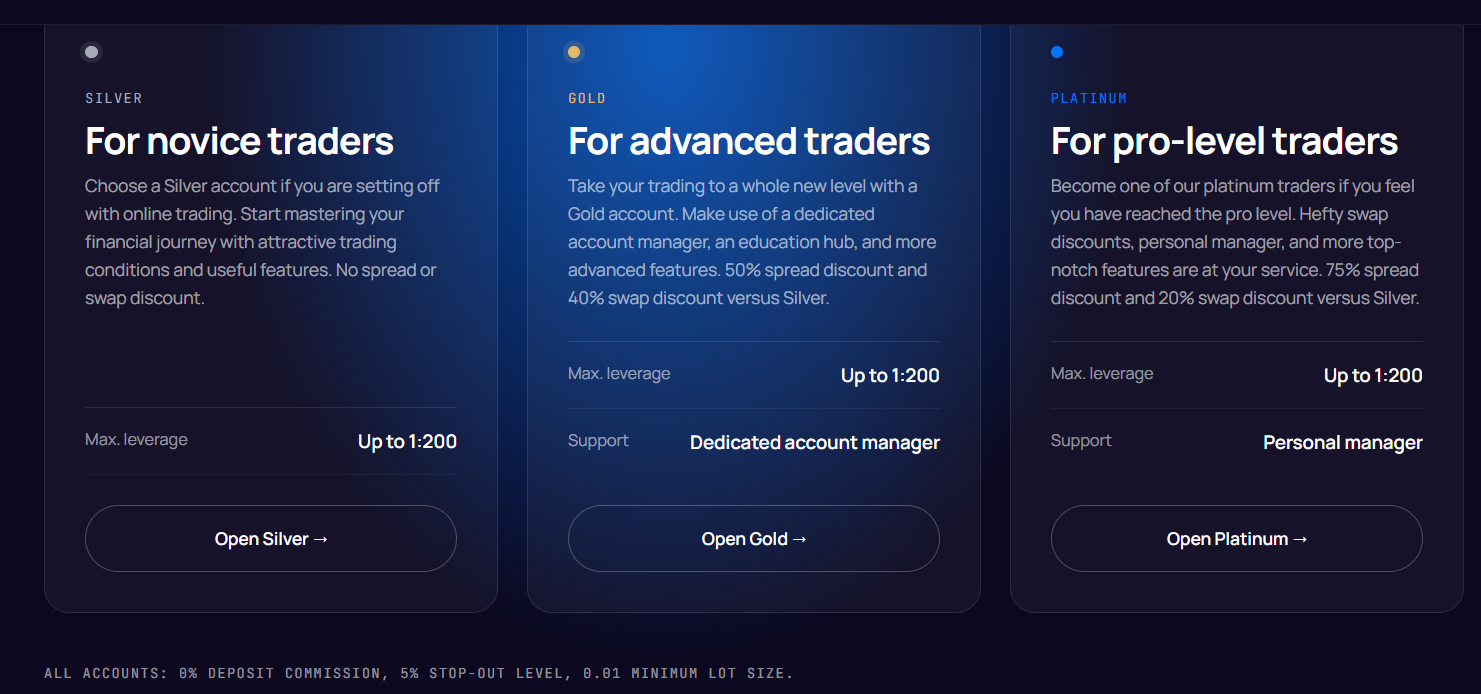
All the broker considered necessary to show traders was:
- Account names: Silver, Gold, Platinum.
- Maximum leverage of 1:200.
- Minimum position size — 0.01 standard lots.
- Stop-Out level — 5%.
There is also one additional feature for each of the Gold and Platinum plans: an individual account manager for the former and a personal manager for the latter. We cannot remember seeing such a comprehensive presentation of trading conditions before.
At the same time, we found no spread or swap values at all. So let’s ask an obvious question: if we are not given the figures that determine trading costs, how can we trust claims about competitive conditions in the first place? And here we once again return to our experience: it tells us that trading parameters are usually hidden only by those whose conditions are seriously inferior to those offered by similar projects. Should Seemarket then be considered a broker?
An even more serious problem is related to leverage. Retail clients are offered the opportunity to use leverage of up to 1:200. Let us remind readers that in jurisdictions with the strictest regulation, retail traders are generally subject to a 1:30 limit on major currency instruments. And even with this significantly lower leverage, the overwhelming majority of inexperienced market participants lose money.
What happens if the available position size is increased almost sevenfold? Of course, leverage itself does not guarantee the loss of a deposit, since the outcome depends on the trading system, its rules, and risk management. However, for an inexperienced trader, such leverage dramatically increases the likelihood of suffering a very rapid and substantial loss.
This becomes particularly interesting given that the broker is the sole counterparty to its clients’ trades. If a trader’s loss simultaneously becomes the financial result of the other side of the transaction, there is no need to look far for a motive to increase leverage.
It is also no coincidence that the Stop-Out level is set at just 5%. At a higher threshold, the broker begins forcibly closing positions earlier, limiting the client’s potential loss. At 5%, the trader can bring the account almost to complete depletion before the system stops the trading activity.
Worth noting! This parameter is particularly telling when the minimum deposit is $250. If the Stop-Out is triggered at 5%, only $12.50 would theoretically remain from the original $250. That certainly would not be enough to properly open the next trade without losing everything.
Interestingly, the website does not even provide the minimum deposit amounts for the different account types. We discovered this figure only in the client area when looking at the option for non-trading operations: it is simply impossible to deposit less.
As a result, we get a fairly typical picture. Seemarket claims to offer excellent trading conditions (remember “breakthrough in trading” and “a new financial future”), but it does not actually show them. The characteristics that are published on the website point more toward unacceptable risks than toward an opportunity to trade profitably. Does this look like an honest broker? Obviously not.
The Reality Check
The owners of the project are clearly interested in making potential clients perceive Seemarket as a fully legitimate and regulated broker. However, everything we have seen so far makes us question this. Nevertheless, the website provides information in the footer of its pages stating that the platform operates under Suxxess FX Ltd, a Seychelles-registered company operating under a license issued by the local regulator, the FSA. We decided to verify these claims.

First, we checked the Seychelles business registry. The result was positive. As we can see, a company called Suxxess FX Ltd is indeed registered there. Moreover, not only the company itself but also its business name is officially registered. However, the latter is identical to the legal entity’s name, while there is no mention of Seemarket in the registry at all. In any case, we are more interested in the license.
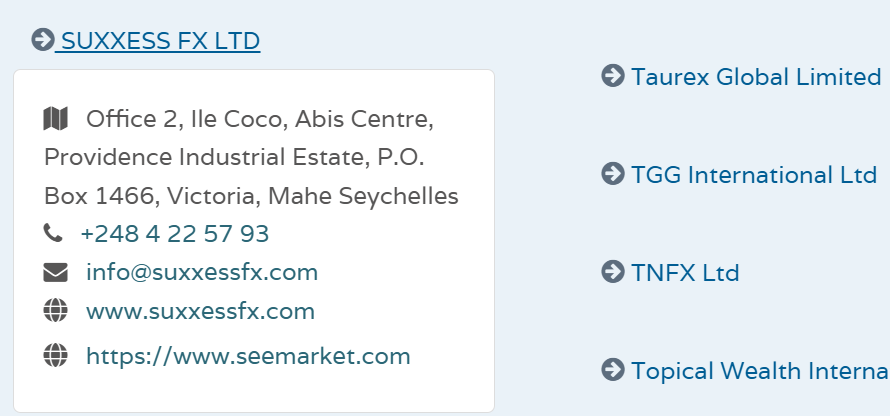
As we can see, checking the database of the Financial Services Authority (FSA) of Seychelles confirms the information provided. Suxxess FX Ltd is indeed a Securities Dealer operating under a valid license. However, what came as a surprise was the fact that seemarket.com actually belongs to the company, as does suxxessfx.com.
What does this mean for a potential client? First of all, it allows us to say that the company genuinely exists within the Seychelles legal framework and is subject to supervision by the local financial regulator. However, we should not jump to overly far-reaching conclusions. The Seychelles FSA is not considered a Tier-1 regulator, so the level of client protection here cannot be compared, for example, with the requirements imposed by the UK’s FCA or Australia’s ASIC.
Of course, we also took a look at the website of the second broker, Suxxess FX, owned by this company. It turned out to look much more like a serious financial service than the one we are reviewing here. We still do not understand why there is such a significant difference in approach. Nor did we find an answer to the question of why one company needs two brokers with different names. The only assumption we can make is that the company intends to reach an audience that it does not serve through its other website (for example, suxxessfx.com does not accept clients from the USA, UK, Russia and the EEA, etc.). However, seemarket.com is even less suitable for working with clients from these jurisdictions, as it appears to disregard virtually all conceivable requirements imposed by regulators, not only Tier-1 authorities but also less authoritative ones.
The FSA of Seychelles license cannot be called fictitious. However, it would also be wrong to treat it as an unconditional guarantee of the safety of client funds. In unofficial international classifications, this regulator is generally considered a Tier-2 authority. This status means that the company is subject to government supervision, but the requirements and level of client protection are below the standards established by the most reputable regulators.
The difference becomes especially noticeable when comparing specific requirements.
- Capital. The FSA’s minimum capital requirements for licensed companies are relatively low. For a Securities Dealer, the threshold following the 2024 legislative update is USD 100,000. For a broker, this does not represent a particularly substantial financial cushion. By comparison, Tier-1 regulators impose significantly higher requirements: the FCA’s threshold is roughly USD 730,000, while ASIC sets a requirement of around AUD 1,000,000.
- Client protection. The differences are even more significant here. Seychelles does not have an Investor Compensation Scheme that would provide guaranteed compensation to clients in the event of certain financial problems affecting a broker. In addition, the regulator does not impose the same stringent set of requirements for the protection of client funds and trading conditions that applies in the most developed financial jurisdictions. In particular, there is no maximum leverage restriction.
- Specifics of the jurisdiction. Seychelles remains an international offshore financial center. It is attractive to businesses because of relatively low operating costs, tax advantages, and a more lenient regulatory environment. This is precisely why companies that may find it difficult to meet the requirements of stricter jurisdictions often choose to operate here. The registration process itself is also relatively fast: obtaining corporate documents can take only a few days, while the cost of the procedure is comparatively low.
So, the FSA of Seychelles license can certainly be regarded as confirmation that a company is registered and operates in accordance with local laws. However, we would not treat it as a guarantee of unquestionable reliability.
For readers, it is particularly important to understand the difference between two statements: “The broker has a valid license” and “The client’s money is reliably protected” are not the same thing. In Seemarket’s case, the first statement is confirmed. The second requires much more substantial evidence.
In addition, an offshore license in itself does not prevent scammers from using regulated status as a marketing tool. After obtaining a relatively accessible regulatory authorization, an unscrupulous project can present it to potential clients as proof of reliability and then recover the licensing costs from the funds it attracts. Everything we have examined so far suggests that the likelihood of Seemarket’s owners being willing to take the same approach is fairly high.
How Long Has Seemarket Been in the Game?
Now let’s address another important question: how long has this broker actually existed? We tried to determine when it started operating by examining WHOIS data. This method cannot be considered absolute proof of the actual launch date of a brokerage business, but it does allow us to establish the age of the domain and obtain at least a starting point for further checks.
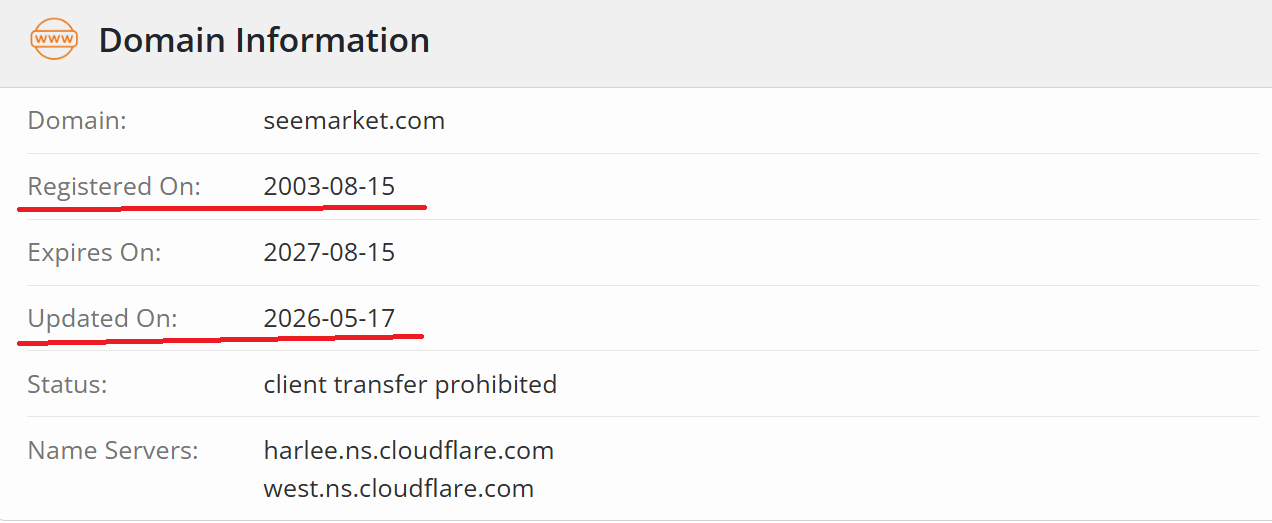
As we can see, we were not mistaken. According to the information we obtained, the broker’s domain mentioned in our seemarket.com review was registered in August 2003. However, we cannot even entertain the idea that such a poorly designed website has existed for more than 20 years.
This was also confirmed by snapshots from the Web Archive. Here, it is clearly visible that in 2023, 2024, and 2025, the domain was listed for sale. There is no recent snapshot from 2026 yet, which suggests that the broker purchased it quite recently. We can say that this happened no earlier than the date of the last significant change, which is recorded as May 17, 2026. Therefore, it is obvious that the platform has been operating online for no more than half a year. This explains many of the things we see on the project’s website, although in our view, certainly not all of them.
Extra Fraud Indicators
There is one more important source of information about the broker that we need to examine — its reputation online. And here we found another confirmation of its “young” age. Seemarket is still unknown both to traders (there are no reviews of its services yet) and to experts from specialized websites.
So far, we have found only a couple of mentions of it, and they are quite categorical in their assessments. For example, the Seemarket page on Wikilix states that the broker is a scam and assigns it a very low safety rating. These findings are consistent with our own conclusions.
Is Seemarket the Right Fit?
In our Seemarket review, we have shown that there can be no question of traders placing any trust in this project. Yes, it has an official registration and a Seychelles FSA license. However, the website does not provide a single bit of critically important information about trading conditions or the terms of non-trading operations. At the same time, the platform was created only a few months ago, so there is hardly any reputation to speak of.

I was persuaded to open and fund an account with Seemarket. What can I say? I am disappointed and convinced that this is a scam. It is simply impossible to trade, you can never get any help from the managers, and all they want is for you to make more and more deposits. After two weeks, I was simply exhausted by their calls, and now I want to cut ties with them for good. I submitted a withdrawal request, so we’ll see how they handle it.